← Profile/Research/EMICREUER-BCN
EMICREUER-BCN
Atmospheric emissions from cruise ships in the port of Barcelona: a 2012–2025 inventory, the impact of international regulation and energy-transition scenarios.
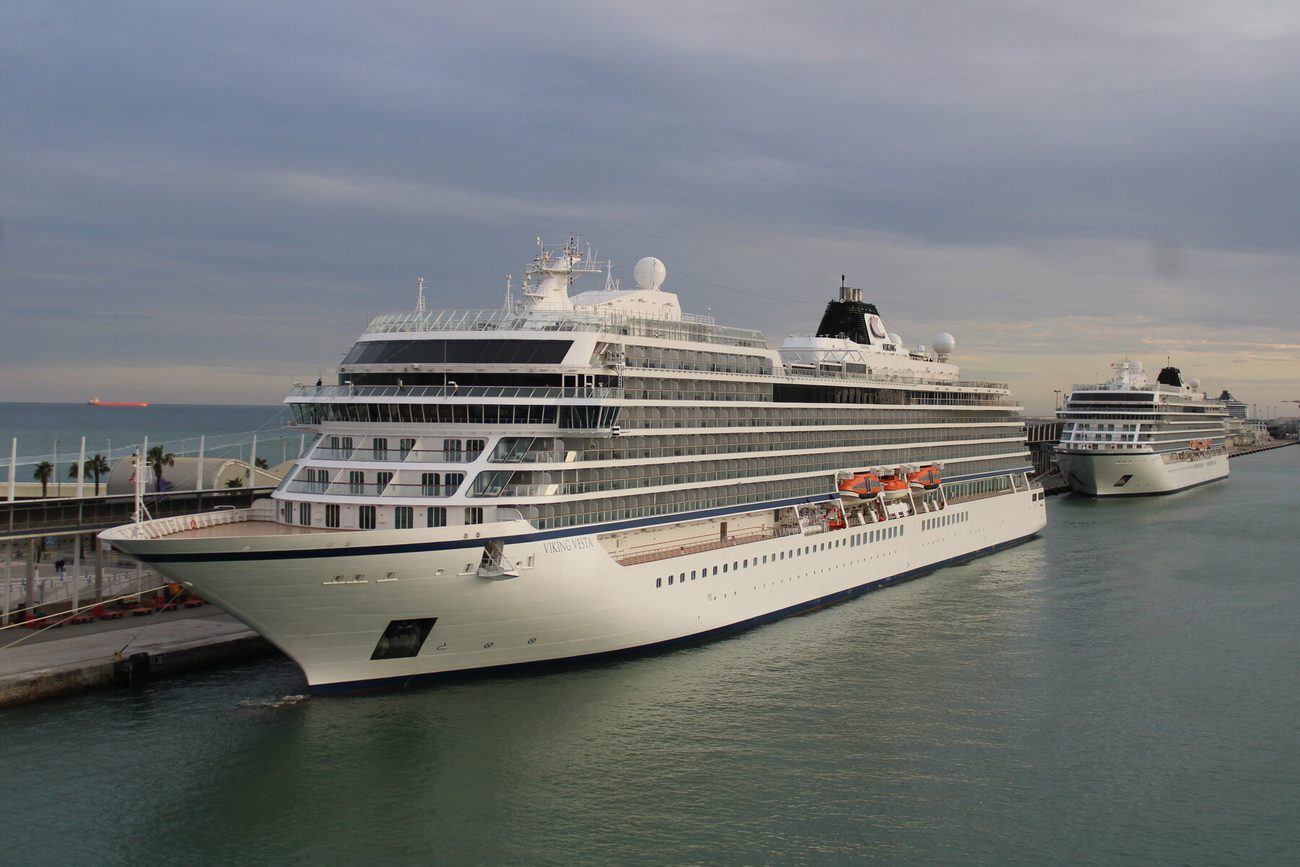
The Viking Vesta and Viking Star at the Moll Adossat · Anthony Levrot / Wikimedia Commons, CC BY-SA 4.0
Manuscript in preparation · Grew out of a final-year project · No external funding
Barcelona is the busiest cruise port in Europe — and, by several accounts, also one of the most affected by the air pollution cruise ships generate. While berthed, they run their auxiliary engines continuously to power lighting, air conditioning and galleys —so-called “hotelling”— releasing NOx, CO, particulate matter (PM), black carbon (BC) and CO₂ right beside densely populated neighbourhoods such as Ciutat Vella and La Barceloneta.
EMICREUER-BCN builds the first ship-by-ship emissions inventory for the port of Barcelona over the 14 years from 2012 to 2025, tracking how pollution has evolved alongside the growth of port infrastructure and the rise of “mega cruise ships”. The aim is a transparent, reproducible baseline that the port authority and regulators can use to plan shore-side electrification (cold ironing) and to assess forthcoming Mediterranean air-quality regulation.
Study area
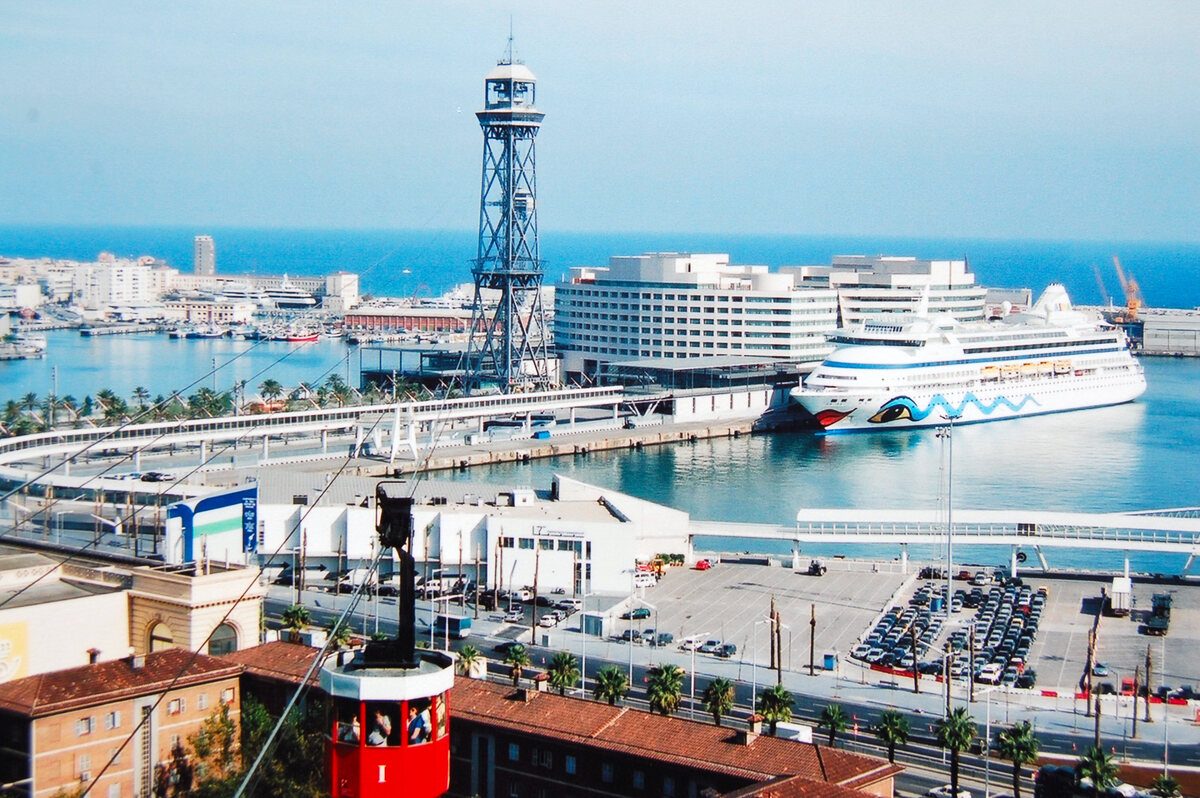
The Port of Barcelona, Europe’s busiest for cruise passengers, less than 1 km from Ciutat Vella and La Barceloneta
Moll Adossat, Port de Barcelona
Cruise terminals A–F · Satellite imagery (Esri World Imagery, on the OpenStreetMap/Leaflet stack)
Methodology
A Tier 3 model (EMEP/EEA Guidebook 2023), computed call by call and activity by activity
Call-by-call inventory
9,487 official Port of Barcelona calls (2012–2025) cross-matched by IMO number, MMSI and ship name.
Engine power database
377 records for 343 unique ships (Port de Barcelona, IHS-Sea, MarineTraffic, CruiseMapper, VesselFinder); 99.9% coverage.
Tier 3 model
E = P × LF × EF × T per phase (cruising, manoeuvring, hotelling), with main and auxiliary engines treated separately.
Data quality audit
21 ships with conflicting power figures, checked one by one against shipyard and operator specifications; 18 corrected, 1 confirmed.
Year-specific emission factors
Adjusted for the uptake of Tier I→II engines (NOx) and the 20% drop in PM following the global sulphur cap (2020).
Monte Carlo uncertainty
10,000 iterations for the six pollutants, plus a sensitivity analysis on the auxiliary-to-main power ratio.
External validation
Comparison with the official Barcelona Port Authority inventory (2017) and with Transport & Environment (2023).
Reproducible implementation
Python (pandas, NumPy), 77 unit tests and an automated quality-control pipeline.
Origin: a student thesis
A final-year project that grew into a full 2012–2025 inventory
“Quantifying air pollutant emissions from cruise ships in the Port of Barcelona”
The project began as the final-year project of Laura Seoane Álvarez, defended on 12 June 2025, comparing port emissions in two years (2017 and 2024) and awarded a best-poster prize. The work was carried out with the Centro Tecnológico Naval y del Mar (CTN), co-supervised by Dr Iván Felis Enguix, during Laura’s curricular placement at the centre.
Building on that foundation, Marc Cerdà i Domènech (GMAR-UB) has extended the analysis to the full 2012–2025 series, adding the data quality audit, year-by-year emission factors, Monte Carlo uncertainty quantification and 2030–2050 transition scenarios, in a manuscript currently in preparation.
Team
An in-house GMAR-UB project, with no consortium and no external funding
Marc Cerdà i Domènech
GMAR-UB · original idea, extension of the analysis to the 2012–2025 series and drafting of the manuscript.
Laura Seoane Álvarez
UB, BSc in Marine Sciences · author of the original 2025 final-year project, the database and the initial 2017–2024 analysis.
Dr. Iván Felis Enguix
Centro Tecnológico Naval y del Mar (CTN) · co-supervisor of the final-year project.
Raül Ávila
MSc student in Water Science and Integrated Management · during a work placement, developed a web tool (GitHub) for quantifying emissions.
Ona Sanz
BSc student in Marine Sciences · author of the most recent final-year project linked to the project.
Affiliation